Theresa Morgan (Therapy Support Worker) and Thomas Liddell (Band 6 Physiotherapist) working for ESDS (Early Supported Discharge Service) at UHL (University Hospital Leicester).
BLOG POST
Inspired by Jenna Oldham’s (band 7 Physiotherapist) strong interest in reducing the carbon footprint and our own personal motivations the project was born, starting in November 2021. At this point the project title was 28 words long :
Is it effective to educate stroke survivors to change their lifestyle to greener methods of increasing their physical activity and eating more of a healthy plant based diet?
Slimmed down to half the word length – the title of this article!
As a physiotherapist, Tom has an interest in motivating and increasing activity in patients, post stroke. The aim here is for patients to see the benefit of reducing car use by increasing active mobility such as walking or cycling as a car replacement, thus reducing carbon footprint.
I have had a long standing interest in reducing meat consumption. Given the link between a diet low in meat consumption being kinder to the planet and being beneficial to the secondary prevention of stroke, I saw this as an exciting opportunity.
The project proposal was then pitched to BIASP. Selected as a runner up in the competition, this resulted in Tom and I winning a place on the SUSQI (SUStainability Quality Improvement course).
The SUSQI theory course was completed in the beginning of 2022. Coming away with lots of ideas, inspiration and tools to support SUSQI, lots of reflection time followed to pull together a way to ensure this was manageable within our current, very busy workload. We soon recognised that our plans were for a relatively big study and we only had a short space of time to complete this in, a rethink was needed.
Initially we were intending to assess patient’s change in behaviour over time, to follow 10 patients over a 10 month timeframe. However, in order to complete the project in the given time, and to ensure that it could be balanced within the restraints of work commitment, the project was slimmed down to focus on just gathering data from 10 previous patients, to gain a snapshot of their experiences of lifestyle and diet changes post stroke and how they felt that ESDS has influenced this at all.
Ideas including motivational interviewing (MI) and food frequency questionnaires were considered. MI techniques looked promising, but the reality of training the team up in this in the short time frame and with staffing limitations, then seemed unrealistic. Links were sent to staff for the opportunity to take the idea on board if they wanted. A standardised food frequency questionnaire was more difficult to get hold of than expected, even when liaising with the UHL dietetics team. A food frequency questionnaire was not then included.
A simple questionnaire was developed that could be asked to patients over the phone, to find out if people made changes to their diet and lifestyle post stroke, if so, what were the main factors that influenced and motivated this change. Another questionnaire was developed to survey staff’s attitudes and behaviours to this.
Ten patients and ten members of the multidisciplinary team were surveyed. The results were collated, conclusions drawn and next steps decided to take the findings forwards.
From this a poster was produced and presented at the UKSF (UK Stroke Forum) 2022.
The project will continue to be progressed and refined at a further SUSQI workshop in January 2023, as clearly sustainability is key – both in terms of the project, the environment and benefits to patients ongoing health.
Then our next steps now are to review and renovate lifestyle patient information, alongside ensuring staff are trained in lifestyle promotion linked with environmental impact.
However, should the opportunity for another similar project arise, some changes would be made in the process:
-In project planning, we would have liked to have gained a greater understanding of the process before thinking of our intentions and launching into the project. This wisdom has been particularly highlighted from our learning on the SUSQI project.
-We would allow more time for collecting data and information.
-More thought could be applied to the aims, questions and what info we want to gain. More consideration could be given to how success or failure can be measured.
– We would have given considerations to limitations of our work setting.
So, why take part in completing project like this? Overall, the project helped us, our team and some patients, to focus on sustainable healthcare and how small changes can be made to potentially encourage others to reduce their carbon footprint. It has bought ‘greener thinking’ that little bit more to mind for staff and patients
From a personal perspective, the opportunity to present our poster at the UK Stroke Forum 22 was a bonus, as well as the learning curve and reflection of project organisation and management!
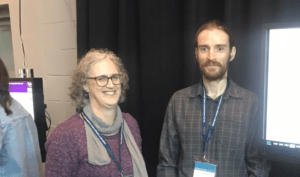
Theresa and Thomas at UK Stroke Forum 22